


China Best Rock Wool Sandwich Panel Manufacturers?
Choosing among China’s best rock wool sandwich panel manufacturers requires more than comparing prices or catalog images. Buyers need evidence of stable production, tested fire performance, accurate dimensions, and dependable project support. A qualified supplier should explain core density, panel thickness, facing materials, joint design, and installation limits clearly. Factory experience also matters when panels must fit cold rooms, workshops, warehouses, or commercial buildings.
This guide examines manufacturers through practical buying criteria. It considers production equipment, quality-control procedures, technical certifications, export experience, and customer feedback. A reliable factory should provide samples, inspection records, clear specifications, and traceable batch information. Site conditions deserve equal attention. Humidity, wind exposure, temperature changes, and local building requirements can affect panel selection. A product that performs well in one region may need different protection elsewhere.
There is no single best manufacturer for every project. That point is easy to overlook. Some companies offer competitive prices but limited engineering support. Others provide stronger documentation at a higher cost. Buyers should request detailed quotations and compare the complete supply scope, not only the panel price. Ask how the rock wool sandwich panel is tested, packed, delivered, and supported after installation. Small details can prevent expensive delays, although supplier claims still require verification. Independent inspections and sample testing remain sensible steps. This overview aims to help architects, contractors, distributors, and facility owners make informed decisions. It focuses on measurable performance and realistic project needs, rather than broad marketing promises.
What Are Rock Wool Sandwich Panels?
Rock wool sandwich panels are factory-made building elements with a mineral wool core between two protective metal facings. The core is formed from spun volcanic rock fibers, creating a lightweight layer that limits heat transfer and slows flame spread. Typical thermal conductivity values range from about 0.035 to 0.045 W/m·K, depending on density and testing conditions under EN 13162. They are used for warehouses, cold rooms, workshops, and industrial walls or roofs.
Their value extends beyond insulation. The 2023 Global Status Report for Buildings and Construction states that buildings consumed about 34% of global energy in 2022 and produced nearly 37% of energy- and process-related carbon emissions. Better envelope design matters. However, a panel is not automatically fireproof. Many rock wool products can meet high reaction-to-fire classifications, but the complete assembly depends on facings, joints, fasteners, and installation details.
Seams matter greatly.
In practice, poorly compressed joints can create thermal bridges and allow moisture into the core. Correct cutting, sealed overlaps, and suitable fixing systems protect performance. I have found that project teams sometimes focus only on core thickness. That is an incomplete judgment. Acoustic performance also changes with panel density, surface design, and room construction. The honest limitation is simple: rock wool panels reduce heat and noise, but they cannot correct careless detailing or poor maintenance.
How Are Rock Wool Sandwich Panels Made in China?
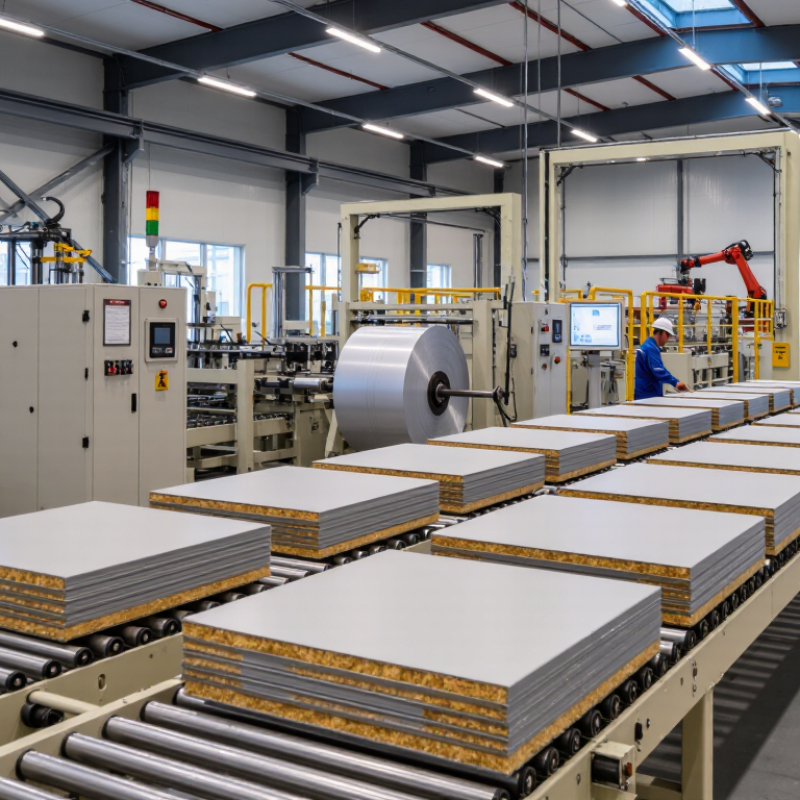
In Chinese factories, rock wool sandwich panels begin with basalt, dolomite, or recycled mineral feedstock. The materials are melted at roughly 1,400–1,500°C. High-speed spinning then turns the melt into fine mineral fibers. A controlled binder is added before the fiber mat enters a curing oven. Small errors matter.
After curing, automated saws cut the core to a specified thickness and density. Steel sheets are cleaned, profiled, and coated before bonding on both sides. Continuous lines control pressure, temperature, and panel speed. Operators still inspect edges, joints, and surface flatness manually. That human check is imperfect, but useful.
Testing usually covers thermal conductivity, density, compressive strength, fire behavior, and water absorption. Buyers should request batch records and reports from accredited laboratories, not only factory photographs. EN 13162 and applicable Chinese standards provide reference methods for mineral wool products. The IEA’s Buildings report states that buildings consume about 30% of global final energy. The 2023 UNEP Global Status Report links buildings and construction to approximately 37% of global energy-related emissions. Better insulation therefore has practical value, although factory quality can vary. A panel may meet a nominal thickness while showing uneven fiber orientation or weak joints. Sample testing remains essential, especially for cold storage, workshops, and high-humidity buildings.
What Defines a High-Quality Chinese Manufacturer?
A high-quality Chinese rock wool sandwich panel manufacturer proves performance through details, not polished promises. During a factory assessment, inspect the core density, panel thickness, and edge alignment. Uneven cuts can create cold bridges and installation gaps. The rock wool should remain tightly fitted inside the steel skins. It should not crumble when handled.
Reliable manufacturers provide traceable material records, production drawings, and independent test reports. Check fire resistance, thermal conductivity, water absorption, and sound insulation data. Ask whether testing covers the exact panel structure you will purchase. Generic certificates are not enough. Production control also matters. Look for calibrated cutting equipment, controlled lamination pressure, and routine dimensional checks. A sample panel should match the approved specification, including coating thickness and joint design.
Communication reveals professional maturity. A capable supplier explains limitations instead of promising everything. They should discuss local climate, span requirements, fastener spacing, and transport protection. Factory visits, video inspections, and pre-shipment checks improve accountability. Still, no evaluation is perfect. A clean workshop may hide inconsistent night-shift production. One approved sample cannot represent every batch. Request random samples and retain inspection records. That extra step feels slow, but it can prevent costly replacement work. Reliability comes from repeatable evidence, responsive engineering support, and honest handling of problems after delivery.
How to Compare China’s Leading Rock Wool Panel Suppliers?
China’s leading rock wool sandwich panel suppliers should be compared by evidence, not attractive brochures. Request the rock wool density, thermal conductivity, compressive strength, and fire performance for each panel thickness. Check whether the test reports match the exact core material and production model. A report for another product proves little.
Inspect the panel sample closely. Measure its thickness with a caliper, examine the steel edges, and check whether the rock wool fills the joint without visible gaps. Ask about steel coating thickness, adhesive coverage, tongue-and-groove accuracy, and dimensional tolerance. Small gaps can create cold bridges and reduce practical insulation performance. They may not appear in a catalog.
Factory experience also matters. Review quality-control records, batch traceability, production capacity, and packaging methods for long-distance shipping. Ask for recent project references with similar temperature, wind, and humidity conditions. A video tour helps, but an independent factory audit is stronger. I once trusted a clean sample too quickly; later, uneven adhesive coverage raised installation concerns. That mistake taught me to compare several batches, not one panel. Discuss lead times, replacement procedures, and technical support in writing. Clear answers usually reveal more than polished sales language.
China Best Rock Wool Sandwich Panel Manufacturers? - How to Compare China’s Leading Rock Wool Panel Suppliers?
| Comparison Dimension | Typical Industry Reference | Recommended Evaluation Method | Importance | Buyer Evidence to Request |
|---|---|---|---|---|
| Core Material | Non-combustible mineral wool or rock wool designed for sandwich panels | Confirm the core composition, fiber orientation, organic binder content, and intended application | High | Technical datasheet, material declaration, and production inspection record |
| Core Density | Common commercial range: approximately 80–150 kg/m³; the required value depends on fire, acoustic, and structural performance | Compare the declared density with the tested panel configuration rather than evaluating density alone | High | Batch test reports, density tolerance, and sampling procedure |
| Panel Thickness | Common options include approximately 50, 75, 100, 120, 150, and 200 mm | Select thickness according to thermal, fire, acoustic, and structural calculations | High | Dimensional tolerance data and cross-sectional drawings |
| Thermal Conductivity | Rock wool products commonly declare design or reference values around 0.035–0.045 W/m·K, depending on density and test conditions | Compare values tested under the same temperature, moisture, and calculation method | High | Laboratory report identifying test temperature and declared value |
| Fire Classification | Mineral wool cores may achieve high reaction-to-fire classifications, but the complete panel classification depends on facings, adhesives, joints, and configuration | Evaluate the complete assembled panel, not only the rock wool core | Critical | Valid fire-test report, classification report, and tested assembly details |
| Fire Resistance | Resistance periods such as 30, 60, 90, or 120 minutes may be available, but results are configuration-specific | Check the tested thickness, span, joint design, support condition, and load requirement | Critical | Fire-resistance report issued by a competent accredited laboratory |
| Acoustic Performance | Performance varies significantly with thickness, joint design, facings, and installation; laboratory ratings should be used instead of generic claims | Compare weighted sound reduction results for the exact panel and joint system | High | Acoustic test report, frequency data, and installation details |
| Steel Facing | Common facing thicknesses are approximately 0.40–0.80 mm, depending on application and structural requirements | Verify actual thickness, coating type, coating mass, yield strength, and corrosion-protection requirements | High | Mill certificate, coating certificate, and incoming-material inspection records |
| Panel Width and Length | Effective widths commonly fall around 950–1,200 mm; production lengths are often made to order within transport and handling limits | Confirm effective cover width, maximum practical length, tolerances, and cutting accuracy | High | Approved shop drawings and dimensional inspection report |
| Joint and Water-Tightness Design | Tongue-and-groove or concealed-fixing systems are commonly used; sealing quality is installation-dependent | Review joint geometry, sealant compatibility, fastener arrangement, and drainage provisions | Critical | Section drawings, installation manual, and water-resistance test evidence where required |
| Dimensional Tolerance | Tolerance requirements should be defined according to the applicable product standard and approved drawings | Use a written tolerance schedule covering thickness, width, length, squareness, and surface flatness | High | Quality-control plan and pre-shipment inspection records |
| Applicable Standards | Relevant requirements may be based on EN, ASTM, ISO, or local building standards, depending on the destination market | Require the supplier to identify the exact standard edition and test method used | Critical | Standard compliance statement and traceable third-party test reports |
| Production Capacity | Capacity varies widely by line size, product type, and shift arrangement; published capacity should not be treated as guaranteed available capacity | Evaluate confirmed monthly capacity against the project schedule and peak-season demand | High | Production schedule, line photos or audit records, and capacity confirmation |
| Lead Time | A practical purchasing benchmark is approximately 2–6 weeks after design approval, subject to quantity, customization, and raw-material availability | Separate design approval, production, inspection, and shipping time in the schedule | High | Written production schedule and delivery commitment |
| Minimum Order Quantity | MOQ is project-specific and may depend on thickness, color, coating, profile, and production setup | Compare MOQ with the project quantity and identify charges for small or mixed orders | Medium | Formal quotation showing MOQ, setup charges, and mixed-load conditions |
| Quality-Control System | A reliable process should cover incoming materials, lamination or bonding, dimensional checks, appearance, packaging, and final release | Audit the process and confirm whether inspection results are traceable to batch numbers | Critical | Inspection and test plan, sample reports, corrective-action records, and traceability procedure |
| Packaging and Container Loading | Panels require moisture protection, edge protection, stable stacking, and loading methods that minimize compression and surface damage | Review packaging materials, stack height, lifting instructions, and container-loading photos | High | Packing specification, loading plan, and damage-claim procedure |
| Technical Support | Support should include drawings, installation details, cutting guidance, fastener recommendations, and response to technical queries | Assess response time and the quality of documents supplied during the quotation stage | High | Sample technical package and named project contact |
| Total Landed Cost | The delivered cost includes panels, accessories, packaging, inland transport, ocean freight, insurance, duties, and local handling | Compare offers using the same thickness, steel specification, Incoterm, quantity, and destination | Critical | Itemized quotation and clearly stated Incoterm, exclusions, and validity period |
| Warranty and Claims Handling | Warranty terms should define coverage, exclusions, storage requirements, installation conditions, and claim-response procedures | Compare the written warranty rather than relying on verbal promises | High | Signed warranty document, claims process, and replacement or remedy terms |
Which Industries Use Rock Wool Sandwich Panels?
Rock wool sandwich panels serve industries that need thermal control, fire performance, and durable wall systems. Their mineral fiber core helps reduce heat transfer and can limit flame spread when properly specified. Performance still depends on panel density, joints, fasteners, and installation quality.
Cold storage facilities use these panels around chilled rooms, loading areas, and temperature-controlled corridors. Food processing plants often choose them because smooth metal surfaces are easier to clean. In these facilities, small gaps around doors can create condensation and hygiene problems. Pharmaceutical manufacturing and laboratory buildings may use rock wool panels for controlled rooms, where stable temperatures and reduced noise support sensitive operations. Clean installation matters.
Warehouses and logistics centers benefit from their insulation and sound-reduction properties. Data centers may use them in partition walls, especially where fire separation and equipment noise require attention. Agricultural buildings, workshops, and public infrastructure projects also use rock wool systems when resilience is more important than the lowest initial price. The material is not a complete solution. Moisture exposure, impact damage, and poor edge sealing can reduce its value. Field inspections sometimes find that the panel is suitable, but the surrounding doors, roof junctions, or service penetrations are weaker. That detail deserves more attention. A practical specification should match the industry’s temperature, hygiene, acoustic, fire, and maintenance requirements.
